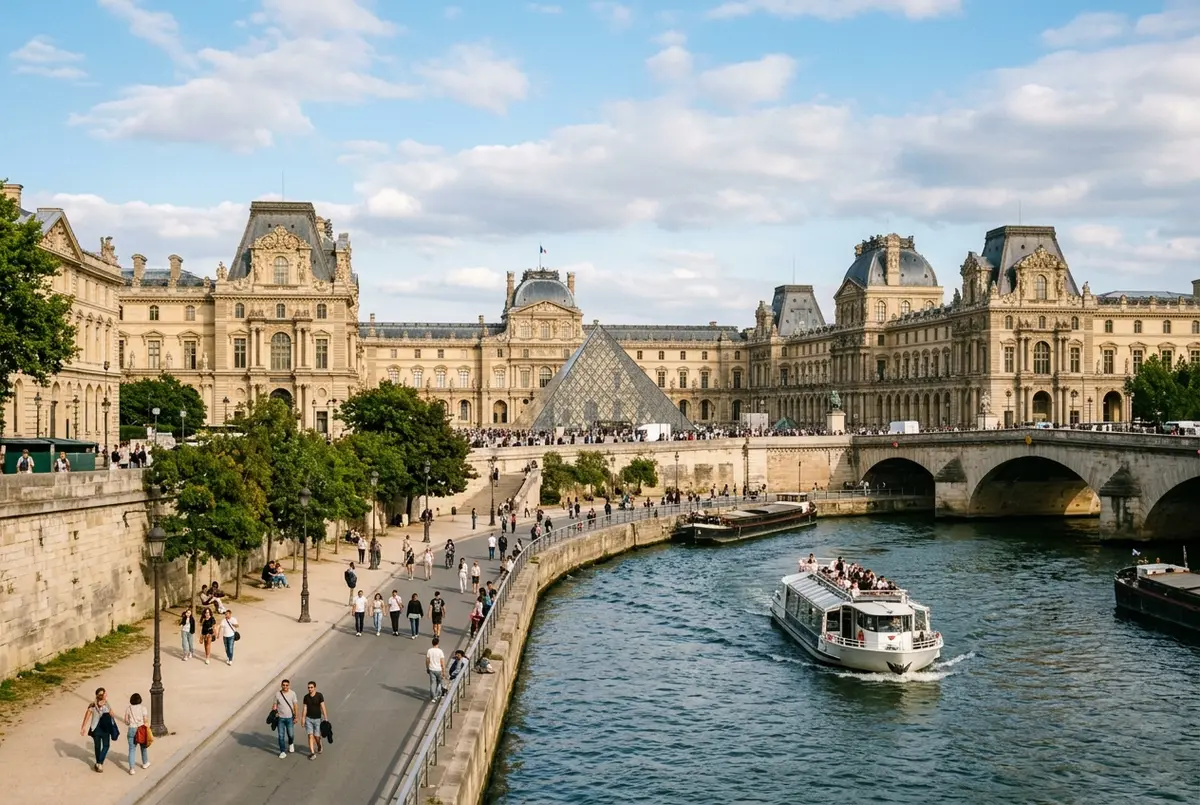
The Louvre Museum Paris France sits on the Right Bank of the Seine, in the city’s 1st arrondissement, and holds a genuine claim to being the world’s largest art museum by floor area. Whether you’ve seen it written as Louvre, Louver, Le Louvre or Musee du Louvre, every version of that name points to the exact same building. Here’s what I’d actually do with that: stop worrying about the spelling and start planning around its sheer scale, because that’s the detail that actually changes how your visit should go.
Everything this museum offers to a visitor, a reserved time slot, a guided route, a small-group cap, traces back to one shared fact: there’s simply too much art here to see without a plan, and my what group size each of the seven Louvre tours and tickets actually takes page lines up every current format against exactly that problem before you book anything.
Where Exactly Is the Louvre Museum Located?
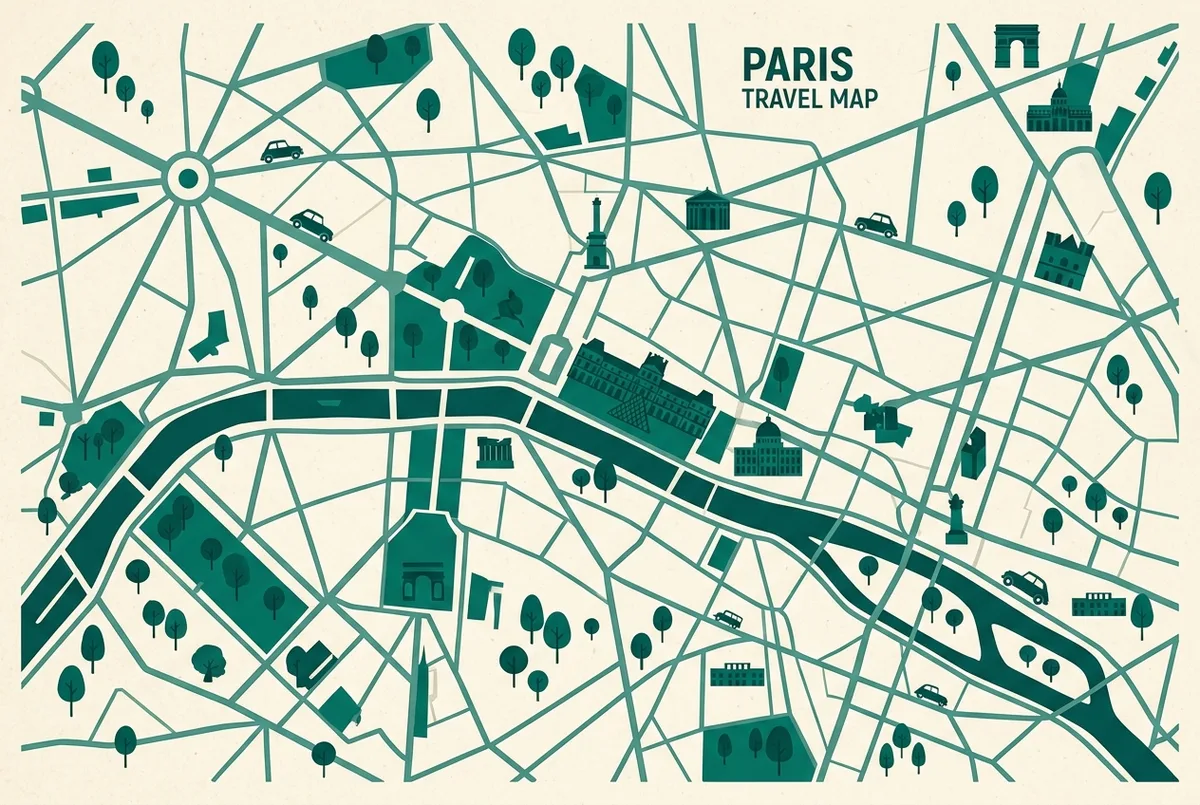
The museum sits directly on the Seine’s Right Bank in central Paris, bordered by the Tuileries Garden to the west and the Rue de Rivoli to the north, with the river itself running along its southern edge. It’s genuinely central: the Palais Royal, the Pont des Arts and the Place de la Concorde are all within easy walking distance.
I’d treat its location as one of the Louvre’s biggest practical advantages. You can pair a museum morning with an afternoon walk through the Tuileries or across the river to the Musee d’Orsay without touching the metro at all, which isn’t true of most of Paris’s major sights.
Is It Called “The Louvre” or “The Louver”?
The Louvre. “Louver” is a common misspelling, likely from how the word sounds when spoken quickly in English, but the correct spelling, both in French and in English-language writing, is Louvre. The full formal name is Musee du Louvre.
I wouldn’t worry about this beyond getting it right when you search or book tickets online; a misspelled search still reliably lands you on the correct museum’s listings, since the confusion is common enough that most booking platforms and search engines account for it.
What Makes the Louvre the World’s Largest Museum?
Its sheer physical footprint and the scale of its permanent collection, which runs into the hundreds of thousands of individual works even though only a portion is on display at any one time. The building itself started as a medieval fortress, became a royal palace, and only later became a public museum, which is part of why its floor plan is so sprawling compared to purpose-built museum buildings elsewhere.
My honest take: “largest” undersells how disorienting that scale can feel in person. I’ve seen plenty of first-time visitors genuinely underestimate how much walking a proper visit involves, purely because no photo conveys how far the Denon wing actually stretches.
What Is the Louvre’s History in Brief?
It began as a 12th-century fortress, was rebuilt into a royal palace over subsequent centuries, and opened to the public as a museum in 1793 during the French Revolution, when the new government opened the former royal art collection to ordinary citizens. The building has been expanded and renovated multiple times since, most visibly with the 1980s addition of the glass pyramid entrance.
I’d recommend reading the fuller version of this story if the history itself interests you beyond just visiting logistics; my Louvre museum history guide covers that full arc from fortress to royal palace to public museum in more depth than I can fit here, and the Wikipedia entry on the Louvre has the fuller academic record if you want to go deeper still.
What Can You Actually See Inside?
Three main wings, Denon, Sully and Richelieu, house the collection, with headline pieces including the Mona Lisa, the Venus de Milo and the Winged Victory of Samothrace alongside a vast range of European painting, ancient Egyptian, Greek, Roman and Near Eastern antiquities, and decorative arts spanning centuries. Most first-time visitors gravitate toward the Denon wing specifically, since that’s where the three most famous pieces all sit.
I’d push back gently on the instinct to chase only the headline three, though. Some of the collection’s most genuinely striking rooms, the Egyptian antiquities and the monumental French paintings in particular, get a fraction of the foot traffic the Mona Lisa room does, and I’d rather see a visitor spend an unhurried twenty minutes there than a crowded ninety seconds craning for a Mona Lisa photo.
Is the Louvre Difficult to Navigate?
Yes, genuinely, and I wouldn’t sugarcoat this for first-time visitors. The building’s layout grew organically over centuries rather than being designed from scratch as a museum, which means corridors, staircases and wing transitions don’t always follow intuitive logic, and it’s common to get at least a little turned around even with a map in hand.
I’d default to a guided format for exactly this reason on a first visit, since a guide’s route knowledge solves the navigation problem far more reliably than a paper map does, and a guide who already knows the floor plan is worth more here than in almost any other museum I can think of.
What Neighborhood Should You Stay In If the Louvre Is a Priority?
The 1st arrondissement itself, or the neighboring Opera and Marais districts, put you within a short walk or single metro ride of the museum without sacrificing access to the rest of central Paris. These areas tend to run on the pricier side for accommodation, but the convenience genuinely pays off if the Louvre is a top priority on a short trip.
I’d weigh this trade-off honestly rather than pretend it’s a clear win either way: a cheaper hotel further out saves money but costs you time and a longer commute on museum morning specifically, when an early arrival matters most for beating the crowds. If the Louvre is the single sight you care most about, I’d pay a bit more to stay close.
Is the Louvre a Good Fit for Families With Kids?
It can be, though I’d manage expectations carefully. A straight, unguided wander through a museum this size tends to lose younger children fast, while a shorter, activity-oriented format built specifically around keeping kids engaged tends to hold their attention far better than a standard adult-paced tour.
I’d choose the format deliberately based on your children’s ages rather than assume any Louvre visit works for any family. A shorter, treasure-hunt-style activity tour tends to hold a young child’s attention far better than a slower, commentary-heavy standard tour built for adults, so match the format to the age group before you book rather than after.
How Does the Louvre Compare to Paris’s Other Major Museums?
It’s considerably larger than the Musee d’Orsay or the Centre Pompidou, both of which can be comfortably covered in a few focused hours, while the Louvre genuinely resists being “finished” even across a full day. The collections differ meaningfully too: the Louvre skews toward ancient and pre-20th-century art, while Orsay specializes in Impressionist and post-Impressionist work and the Pompidou covers modern and contemporary pieces.
I’d actually recommend pairing a Louvre morning with an Orsay afternoon if your itinerary allows it, since the two collections complement each other well and the walk between them along the Seine is one of the nicer short strolls in the city. Trying to do all three major museums properly in a single day, on the other hand, is more ambition than most travelers’ legs can support.
How Do You Get to the Louvre?
The Palais Royal-Musee du Louvre and Louvre-Rivoli metro stations both sit within a short walk of the museum’s entrances, and several bus lines stop even closer depending on which entrance you’re heading for. Most visitors staying centrally in Paris can reach it entirely on foot or with one short metro ride.
For the full breakdown of specific stations, bus lines and walking routes depending on where you’re coming from, my how to get to the Louvre guide covers that ground in detail rather than leaving you to guess at the nearest stop.
How Much Time Should You Budget for a Visit?
I’d budget a minimum of three hours for a focused, guided highlights visit, and closer to a full day if you’re going in without a guide and want to see more than the three headline works. The honest truth is that almost nobody sees the entire Louvre in one visit; even dedicated art lovers tend to pick a wing or theme and go deep rather than attempt everything.
My genuine advice here: decide your priorities before you walk in, not after. A guide who already knows which handful of rooms matter most to a first-timer will get you through a satisfying visit in half the time an unguided wander through the full building takes.
Is There a Best Time of Year to Visit?
Shoulder season, roughly spring and fall outside of school holidays, tends to offer the best balance of manageable crowds and pleasant weather for the walk along the Seine either side of your visit. Summer brings the heaviest crowds of the year, while winter, aside from the holiday weeks themselves, can actually be one of the quieter stretches.
I’d specifically avoid the first week of major French school holidays if you have any flexibility at all, since that’s when I’ve seen booking availability tighten up the fastest and galleries get noticeably more crowded than the surrounding weeks. If your travel dates are fixed regardless of season, I’d simply lean harder on an early morning or late-afternoon time slot to offset whatever the calendar throws at you.
What Should First-Time Visitors Know Before They Go?
Beyond the Tuesday closure and the size of the building, I’d flag that bag restrictions exist for security reasons, so check current rules on permitted bag sizes before you pack for the day. I’d also pack more comfortable shoes than you think you need; the amount of walking a thorough visit involves surprises almost everyone who hasn’t done it before.
My honest advice to any first-timer reading this before their trip: don’t try to see everything. Pick a genuine priority list, book a reserved slot, and accept walking past thousands of works you won’t stop for. That’s not a failure of planning, it’s simply how a collection this size has to be approached, and the visitors who enjoy their trip most tend to be the ones who made peace with that before they ever walked through security.
What’s the Best Way to Approach Ticketing?
Reserved time-slot entry, whether through the official site or a guided partner ticket, rather than showing up and hoping for a walk-up spot, which gets genuinely unreliable during peak season. The museum’s popularity means its best time slots sell out weeks ahead during the busiest months.
I’d book earlier than feels necessary if your trip falls anywhere near a school holiday or the summer peak. My Louvre tickets price guide breaks down exactly what each ticket type costs and how far ahead I’d book each one.
Is the Louvre Worth Visiting If You’re Not an Art Expert?
Absolutely, and I’d say that without hesitation. You don’t need any art history background to find the Louvre worthwhile; a guide or even a well-chosen audio commentary gives you enough context on the handful of pieces that matter most, and the building itself, a former royal palace, is worth seeing independent of the art inside it.
I’d specifically reassure anyone worried they’ll feel lost or bored without expertise: a focused two-to-three-hour guided visit built around a handful of must-see pieces works just as well for a total beginner as it does for someone who’s studied art history for years. The scale of the place is the real challenge here, not the subject matter.
My Honest Recommendation
If this is your first trip to the Louvre Museum Paris France, I’d book a reserved-entry or guided slot rather than risk a walk-up visit, pick either an early morning or late-afternoon time to dodge the worst crowds, and go in with a short, realistic list of what you actually want to see rather than an attempt to cover the whole building. The museum rewards a plan more than almost any other sight in Paris, purely because of its size.
For the wider Paris context, my glass pyramid guide covers the landmark entrance you’ll likely use to get in, and once your route and timing are settled, my complete Louvre ticket and tour list has every current format priced out if you haven’t picked one yet.
Frequently Asked Questions
Is it spelled Louvre or Louver?
Louvre is correct; Louver is a common misspelling that still reliably surfaces the right museum in search results.
Where is the Louvre Museum located in Paris?
On the Right Bank of the Seine in the 1st arrondissement, bordered by the Tuileries Garden and Rue de Rivoli.
Is the Louvre really the world’s largest museum?
Yes, by floor area and the scale of its permanent collection, it holds that title among the world’s major museums.
How long does a Louvre visit take?
I’d budget a minimum of three hours for a guided highlights visit, closer to a full day without a guide.
Do you need to know about art to enjoy the Louvre?
No, a guide or audio commentary gives enough context for a first-time visitor with no art history background to get real value from the visit.