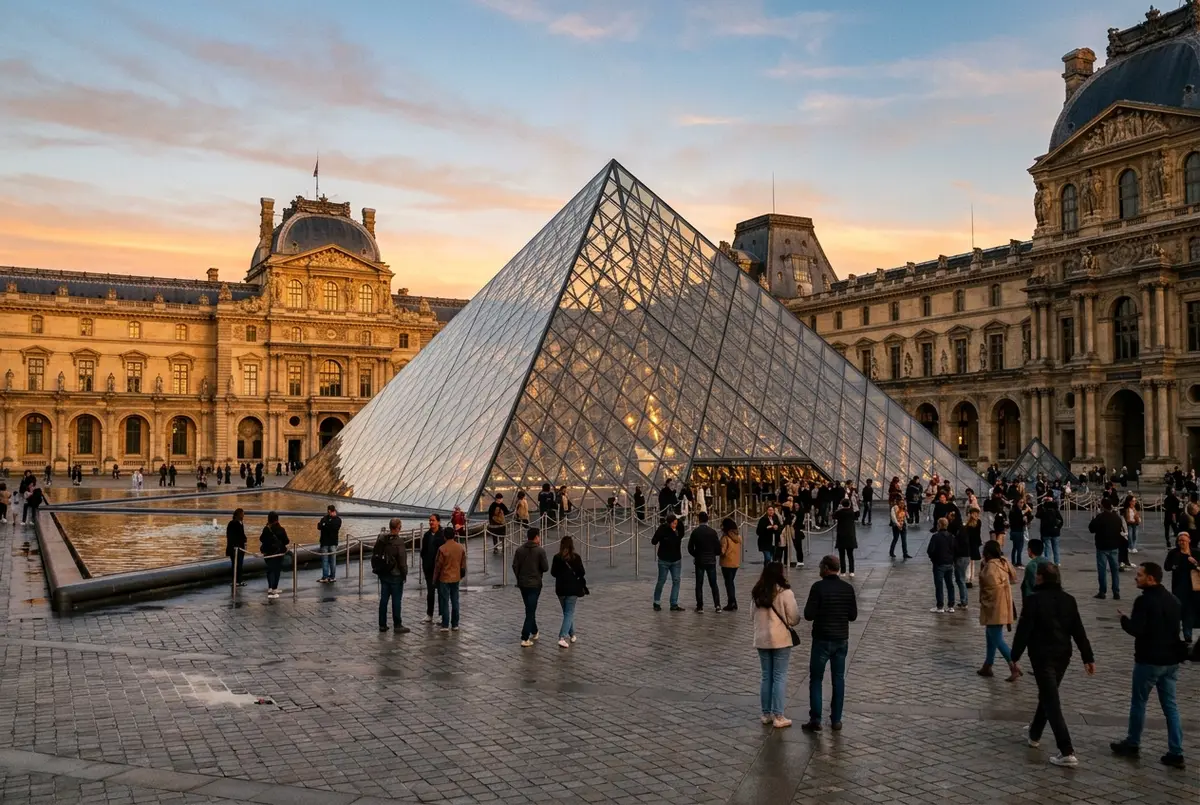
The Louvre Glass Pyramid: History and Visiting Tips
See prices From 59 EUR · Free cancellation available
Contents
The glass pyramid paris travelers keep asking about sits dead center in the Louvre’s Cour Napoleon courtyard, and it is both the museum’s most photographed landmark and its busiest public entrance. Here’s what I’d actually do with that: come for the photo, but don’t assume you have to fight the pyramid’s queue to get inside, because you usually don’t.
Before you plan around the pyramid itself, it’s worth knowing what connects it to the rest of your visit: every current tour and ticket bundles a different level of guidance around the same reserved-entry idea, so what each Louvre tour and ticket actually includes is worth a glance before you lock in how you’re getting in.
What Is the Louvre’s Glass Pyramid, Exactly?
It’s a 21-meter-tall structure made of glass and metal, built directly over the Louvre’s main underground entrance hall and visitor lobby. The louvre paris pyramid isn’t a museum exhibit itself; it’s a functional skylight and entrance canopy that happens to have become the single most recognizable image of the building.
I’d describe it to a first-timer as part sculpture, part front door. Light pours through the glass panels into the lobby below, and on a clear day that lobby is genuinely one of the nicer arrival spaces of any major museum I can think of.
Check prices & dates
Ready to visit?
Book your tickets in advance: popular time slots sell out.
Why Did the Louvre Build a Glass Pyramid in Its Courtyard?
The Louvre needed a bigger, more organized entrance than the scattered doors it had before the 1980s, and a sunken glass structure let architects add that space without burying a new building against the historic palace facade. The pyramid shape won out because it’s the one geometric form that reads as a single clear entry point from every angle of the courtyard.
My honest take: the practical reason matters more than people assume. This wasn’t built for drama first; it was built because the old entrance arrangement genuinely could not handle the crowds, and the museum needed somewhere to put a ticket hall, a bookshop and coat check without touching the original Cour Carree architecture. The whole project was part of a much larger 1980s renovation of the entire museum, commissioned at a presidential level, and the pyramid is really just the visible tip of that underground expansion.
I’d remind anyone picturing a quick add-on that this was never a small job. Building a new entrance hall underneath an active courtyard, next to a palace full of irreplaceable art, took years of planning before a single glass pane went in.
How Big Is the Louvre Pyramid?
Around 21 meters tall and roughly 35 meters wide at its base, made up of 603 rhombus-shaped and triangular glass panes set into a steel and aluminum frame. It’s smaller in person than most photos suggest, since wide-angle shots and the open courtyard around it both exaggerate its scale.
I always warn first-time visitors of this: the pyramid photographs huge but stands only a few stories tall. If you’re picturing something the size of the Giza pyramids, scale your expectations down considerably before you arrive.
What Is the Pyramid Actually Made Of?
Laminated glass panes set into a lightweight steel and aluminum lattice, engineered to be as close to invisible as a structure that size can be. The frame carries the real weight; the glass is there purely to let light through and give the whole thing its signature shimmer.
I’d call out one detail most guidebooks skip: the panes aren’t all identical. The main pyramid mixes rhombus and triangular shapes to cover its sloped faces cleanly, which is part of why the surface reads as a smooth diamond pattern from a distance rather than a flat grid. It’s a small engineering choice that does a lot of the visual work.
Has the Pyramid Changed Since It First Opened?
Only in minor ways. The structure itself has held up well since 1989, though the surrounding courtyard and the underground Hall Napoleon beneath it have been renovated more than once to handle growing visitor numbers. Cleaning and maintenance crews keep the glass clear on a regular schedule, which matters more than you’d think for a structure with this much surface area exposed to Paris weather.
My honest read: the pyramid itself needs surprisingly little explaining as “the new thing” anymore. It has been the Louvre’s entrance for longer than many of today’s visitors have been alive, which is part of why the 1980s controversy around it can feel almost quaint from where we stand now.
Is the Glass Pyramid the Only Entrance to the Louvre?
No. It’s the main and most obvious entrance, but it’s also usually the one with the longest security line, especially mid-morning in peak season. Two quieter alternatives exist for exactly this reason.
I’d steer most readers away from the pyramid doors unless you specifically want the arrival experience that comes with them. My Louvre entrances guide breaks down the underground Carrousel du Louvre entrance and the Passage Richelieu priority entrance, both of which can save you a real chunk of standing-in-line time.
Why Was the Pyramid So Controversial When It Opened?
A glass-and-steel modern structure dropped into the courtyard of a centuries-old royal palace struck plenty of Parisians in the late 1980s as architectural vandalism. Critics at the time called it jarring, out of place, even an insult to the historic building it fronted.
I’d push back gently on anyone who repeats that criticism today without context: three decades of daily use have more or less settled the argument in the pyramid’s favor, and it’s hard to picture the Louvre’s entrance any other way now. If you want the fuller story of the architect behind it and exactly how that controversy played out, my who designed the Louvre pyramid guide covers it in detail, and the Wikipedia entry on the Louvre Pyramid has the fuller technical and historical record if you want to go deeper still.
What’s Inside the Pyramid Itself?
Mostly nothing you’d call an exhibit. Below the glass sits the Hall Napoleon, the museum’s main entry lobby, with ticket counters, an information desk, a bookshop, cloakrooms and access points down to the three main wings: Denon, Sully and Richelieu. The pyramid’s real job is letting daylight reach that lobby, not displaying art.
I’d manage expectations here specifically because I’ve seen visitors assume the pyramid itself is part of the collection. It isn’t. Treat it as the threshold, not the destination, and save your energy for the galleries past it. If you’re trying to plan how much time to budget once you’re actually inside, I’d count the Hall Napoleon as a five-to-ten-minute stop at most: grab your bearings, check the wing map, and move on toward whichever collection brought you here.
Is There an Upside-Down Pyramid Too?
Yes, a smaller inverted glass pyramid, the Pyramide Inversee, hangs point-down from the ceiling of the underground Carrousel du Louvre shopping area nearby. It gained extra fame after appearing in a popular novel and film as a plot device, though the real structure has no secret chamber beneath it.
I’d still send curious visitors to see it, since it’s a genuinely striking piece of architecture on its own and sits just a short walk from the main pyramid, no separate ticket required to view it from the public shopping concourse.
Is the Pyramid Worth Seeing at Night?
Yes, and I’d actually rank it above the daytime version for atmosphere. The glass lights up from within after dark, the courtyard empties out considerably once the museum closes, and the contrast between the illuminated modern structure and the floodlit stone palace around it is the single best photo opportunity the site offers.
I’d build a short detour here into any Paris evening itinerary, even one that has nothing else to do with the Louvre. You don’t need a ticket, it costs nothing, and it takes maybe twenty minutes out of a dinner walk, regardless of whether the museum itself is open that evening or already closed for the day.
What’s the Best Vantage Point to View the Pyramid From?
Standing at the courtyard’s edge near the Richelieu wing gives you the classic symmetrical shot with the palace wings framing both sides. For a different angle, the raised terrace near the Arc de Triomphe du Carrousel, just west of the pyramid, lets you shoot it with the Tuileries Garden stretching out behind you.
I’d try both if your schedule allows it, since they genuinely read as two different photographs. The straight-on courtyard shot is the one everyone takes; the terrace angle is the one that actually looks like you thought about composition for more than ten seconds.
When Is the Best Time to Photograph the Glass Pyramid?
Early morning, right around sunrise, before the courtyard fills with tour groups and the security line starts forming. Blue hour just after sunset is my other pick, when the pyramid’s internal lighting kicks on against a darkening sky.
I’d specifically avoid midday in summer if a clean photo matters to you: harsh overhead light flattens the glass reflections, and the courtyard is at its most crowded exactly then. A soft, low-angle light does more for this structure than any filter will.
Can You See the Pyramid Without Buying a Museum Ticket?
Yes. The Cour Napoleon courtyard is open public space, so you can walk up to, photograph and walk around the pyramid without a ticket or entering the museum at all. You only need a ticket once you want to go through security and down into the Hall Napoleon.
I’d still recommend budgeting the museum visit itself if you’ve come this far, though; the pyramid alone is a nice fifteen-minute stop, but the collection behind it is the actual reason most people fly to Paris in the first place. My Louvre tickets price guide lines up what that visit actually costs across every current ticket type.
How Does the Pyramid Fit Into the Louvre’s Overall Layout?
It sits at the geographic and functional center of the museum’s U-shaped courtyard, between the Richelieu, Sully and Denon wings, which is exactly why it became the natural spot for a unified entrance hall. Once you’re through security, directional signage from the Hall Napoleon routes you toward whichever wing holds what you came to see.
If you’re still getting oriented to the wider site, my Louvre Museum Paris visitor guide covers the building’s full layout and location in the city, which pairs well with understanding the pyramid’s role at its center.
Is the Pyramid a Good Meeting Point If Your Group Splits Up?
Yes, and I’d actively recommend it over trying to find each other inside the galleries. It’s the single most recognizable landmark on site, visible from almost anywhere in the courtyard, which makes it a far easier rally point than a gallery number nobody remembers by lunchtime.
I’d just pick a specific side of it in advance rather than “the pyramid” as a whole, since the courtyard gets wide enough that a vague meeting spot still costs you ten minutes of searching. “Richelieu-side steps” or “the terrace by the Arc du Carrousel” both work better than leaving it general.
Does the Glass Lobby Get Uncomfortably Hot in Summer?
It can, particularly in the early afternoon on a bright July or August day, since the structure is doing exactly what glass does and letting heat in along with the light. The Hall Napoleon below has climate control, but on the hottest days it’s working against a lot of direct sun.
I’d factor this into timing if you’re visiting in peak summer: an early morning or late afternoon entry avoids both the worst of the security line and the warmest stretch of the day inside that glass-topped lobby. It’s a small thing, but it’s the kind of detail that makes a July visit noticeably more comfortable than a visitor expects going in.
My Honest Recommendation
If a great photo matters to you, I’d show up at or just before opening, shoot the pyramid in that first calm half hour, then head straight for security while the line is still short. Treat the structure as the opening scene of your visit, not something to linger over for an hour while the courtyard fills in behind you.
For the entrance itself, I’d default to one of the two quieter alternatives over the pyramid doors unless you specifically want that grand, sweep-down-into-the-lobby arrival. The time saved standing in a shorter line is worth more to most travelers than the extra few minutes of pyramid views on the way in.
Once you’ve got your entrance plan sorted, my current Louvre ticket and tour lineup has every format, guided, self-guided, private and family, priced out if you haven’t picked one yet.
Frequently Asked Questions
What is the glass pyramid at the Louvre?
It’s the museum’s main entrance structure, a glass-and-steel pyramid built over the underground Hall Napoleon lobby in the Cour Napoleon courtyard.
Who built the Louvre pyramid and when?
It opened to the public in 1989 as part of a larger renovation project; my dedicated guide on the architect behind it covers the full story.
Do you need a ticket to see the glass pyramid?
No, the courtyard around it is open public space; you only need a ticket to pass through security into the museum itself.
Is the pyramid the only way into the Louvre?
No, the Carrousel du Louvre underground entrance and the Passage Richelieu entrance both offer alternatives that are often less crowded.
Is there another pyramid at the Louvre besides the famous one?
Yes, a smaller inverted glass pyramid called the Pyramide Inversee hangs in the underground Carrousel du Louvre area nearby.