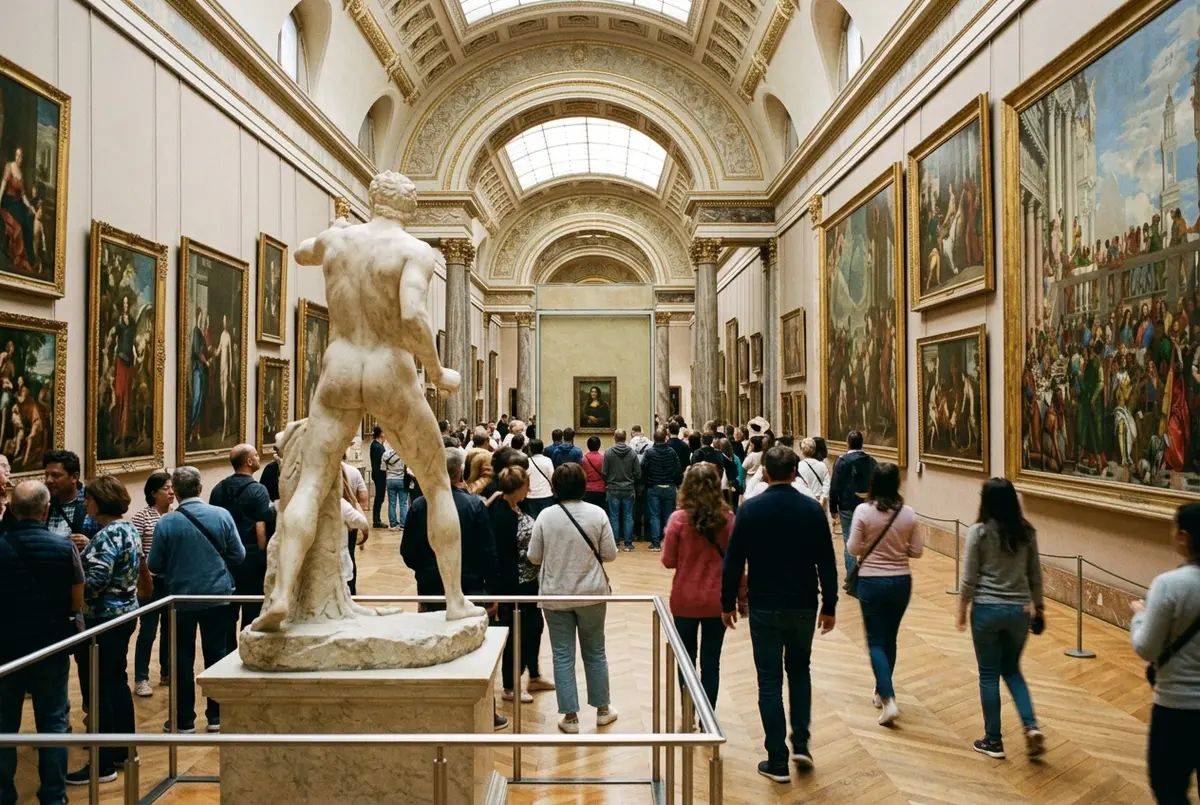
My top ten things to see at the Louvre mix paintings, sculpture, architecture and whole rooms, because limiting a list like this to paintings alone misses half of what actually makes a visit memorable. I’d use this as a practical shortlist for a first visit rather than a strict ranking you have to follow in order.
What Are the Top 10 Things to See at the Louvre?
1. The Mona Lisa. It’s the single most visited painting in the world, and while I’d warn you the room gets genuinely crowded, I still think it earns its reputation up close. My Mona Lisa tickets guide covers the fastest ways to reach this specific room if that’s your priority.
2. The Venus de Milo. This armless marble sculpture, discovered on the Greek island of Milos in 1820, is one of the most recognizable pieces of ancient sculpture anywhere, and I’d rank the ten or so minutes you’ll spend in front of it among the best time investments in the whole museum.
3. The Winged Victory of Samothrace. Headless and armless but still dramatically dynamic, this Hellenistic sculpture stands at the top of the Daru staircase, and I think its placement, mid-flight above a grand staircase, does more for the piece than any gallery wall could. My Venus de Milo and Winged Victory guide covers both sculptures in full.
4. The Glass Pyramid. I.M. Pei’s 1989 entrance is worth a slow look from outside before you go in, not just a walk-through on your way to security. I’d specifically recommend seeing it lit up in the evening if your schedule allows.
5. Liberty Leading the People. Delacroix’s 1830 painting of the July Revolution is large enough to stop you from across the room, and I’d rank it ahead of several better-known names on this list. My Louvre paintings guide covers this piece and several others in more depth.
6. Napoleon III’s Apartments. These lavishly gilded 19th-century state rooms in the Richelieu wing see a fraction of the foot traffic the painting galleries do, and I think they’re one of the most underrated stops in the entire building.
7. The Code of Hammurabi. This nearly 4,000-year-old basalt stele, inscribed with one of the earliest known legal codes, sits in the Near Eastern antiquities galleries, and I’d call it one of the most historically significant single objects in the whole collection, even though it rarely makes headline lists.
8. The Coronation of Napoleon. David’s massive canvas, roughly 6 by 10 meters, depicts Napoleon crowning Josephine rather than himself, and I genuinely think photographs undersell how imposing it feels standing in front of the real thing.
9. The Daru Staircase. Beyond being the Winged Victory’s pedestal, the staircase itself is a piece of 19th-century architecture worth pausing on, and I’d budget an extra minute here even if sculpture isn’t usually your focus.
10. The Islamic Art Department. Housed in a striking modern glass-roofed wing added in 2012, this collection covers more than a thousand years of Islamic art and design, and I’d point anyone who’s already seen the “big three” works toward this gallery next for something genuinely different.
Why Does Everyone Rush to the Mona Lisa First?
Most first-time visitors have heard of exactly one Louvre painting before they arrive, and that name recognition pulls nearly every unguided visitor toward the Salle des Etats within minutes of walking in. That single-minded rush is also why the room stays so consistently crowded throughout the day.
I’d resist that instinct, honestly. If you walk straight past the Venus de Milo and Winged Victory on your way to the Mona Lisa, which is a genuinely common route, you’ll have skipped two of the pieces on this list that deserve just as much attention.
Is It Worth Seeing Anything Beyond the Big Three?
Yes, and I’d say that without hesitation. The Louvre’s “big three”, the Mona Lisa, the Venus de Milo and the Winged Victory, get a huge share of visitor attention, but items five through ten on this list get a fraction of the crowd for, in several cases, nearly as much historical weight.
My honest take is that the Code of Hammurabi and Napoleon III’s Apartments are the two most consistently underrated stops on this entire list. Neither shows up on a rushed two-hour itinerary, and both are genuinely worth the detour if you have any time to spare.
Should You Follow This List in Order?
Not strictly. I’d group it by location instead: the Mona Lisa, Winged Victory and Coronation of Napoleon all sit within a short walk of each other in the Denon wing, while the Code of Hammurabi, Napoleon III’s Apartments and the Islamic Art department are spread across different parts of the building.
I’d plan a route by proximity rather than by this list’s numbering, since chasing items in the exact order above would have you crossing the museum back and forth unnecessarily.
Can You See All 10 Things in One Visit?
Yes, if you’re moving efficiently and not lingering too long at any single stop, though I’d budget a minimum of three hours to do it without feeling rushed. A guided format tends to fit all ten into a tighter window than a self-guided wander does, purely because the guide already knows the fastest path between them.
I wouldn’t try to cram all ten into a two-hour visit unless speed genuinely matters more to you than depth. I’d rather you properly see six or seven of these than rush past all ten.
What If You Have Less Than Two Hours?
Cut the list down to four stops: the Mona Lisa, the Venus de Milo, the Winged Victory and the glass pyramid on your way out, all of which sit on a short, continuous route through the Denon and Sully wings. I’d skip Napoleon III’s Apartments and the Islamic Art department entirely in this scenario, since both sit far enough from the main route that reaching them eats into time you don’t have.
I’d rather you see four things properly in ninety focused minutes than attempt all ten and remember none of them clearly afterward. A guided format tends to handle this kind of tight window better than a self-guided wander does, purely because the guide already knows which four stops to prioritize without wasting time working it out on the fly.
Is This List Different for Repeat Visitors?
Yes, and I’d actively encourage repeat visitors to flip the priorities. If you’ve already seen the Mona Lisa, the Venus de Milo and the Winged Victory on an earlier trip, I’d point you toward the Code of Hammurabi, Napoleon III’s Apartments and the Islamic Art department instead, since all three see noticeably lighter crowds and still carry real historical weight.
My honest take for anyone on a second or third Louvre visit: chasing the same headline three again rarely adds much. The quieter stops on this list are where a repeat visit genuinely pays off.
My Honest Recommendation
If you only have half a day, I’d prioritize the Mona Lisa, the Venus de Milo, the Winged Victory and the Coronation of Napoleon, since those four sit close together and cover both painting and sculpture. Everything else on this list is a genuine bonus if your schedule allows more time.
For the deeper dive on the paintings specifically, my Louvre paintings guide covers the Mona Lisa, Liberty Leading the People and the Coronation of Napoleon in more depth than I can fit into a single list item here. And if you’d rather have a guide handle the route between all ten stops, my louvre museum tickets homepage has every current tour and ticket format.
Frequently Asked Questions
What are the top 10 things to see at the Louvre?
The Mona Lisa, the Venus de Milo, the Winged Victory of Samothrace, the glass pyramid, Liberty Leading the People, Napoleon III’s Apartments, the Code of Hammurabi, the Coronation of Napoleon, the Daru staircase and the Islamic Art department.
Can you see all of this in one day?
Yes, with a focused three to four hour visit, though I’d move efficiently and not linger too long at any single stop to cover all ten comfortably.
Should I see the Mona Lisa first or last?
I’d actually see it mid-visit rather than first, since the room stays crowded all day regardless of timing, and starting elsewhere lets you see quieter pieces before the museum gets busier.
Is the Louvre worth it if you’re not into art history?
Yes. Several items on this list, the glass pyramid, the Daru staircase and Napoleon III’s Apartments, are worth seeing for their architecture and history alone, no art background required.